Book of business
Import your agency's book from an AMS export into Market Tracker, map the columns, read the match states, and act on the signals raised against live FMCSA data.
Book is your own book of business matched against the FMCSA census. Import the book export from your AMS and every client that can be matched becomes a live carrier record, so a cancellation or an authority change on an account you already write shows up without anyone checking manually.
#Importing
- Bring your book in on the Book tab.
- Upload the export from your AMS: CSV.
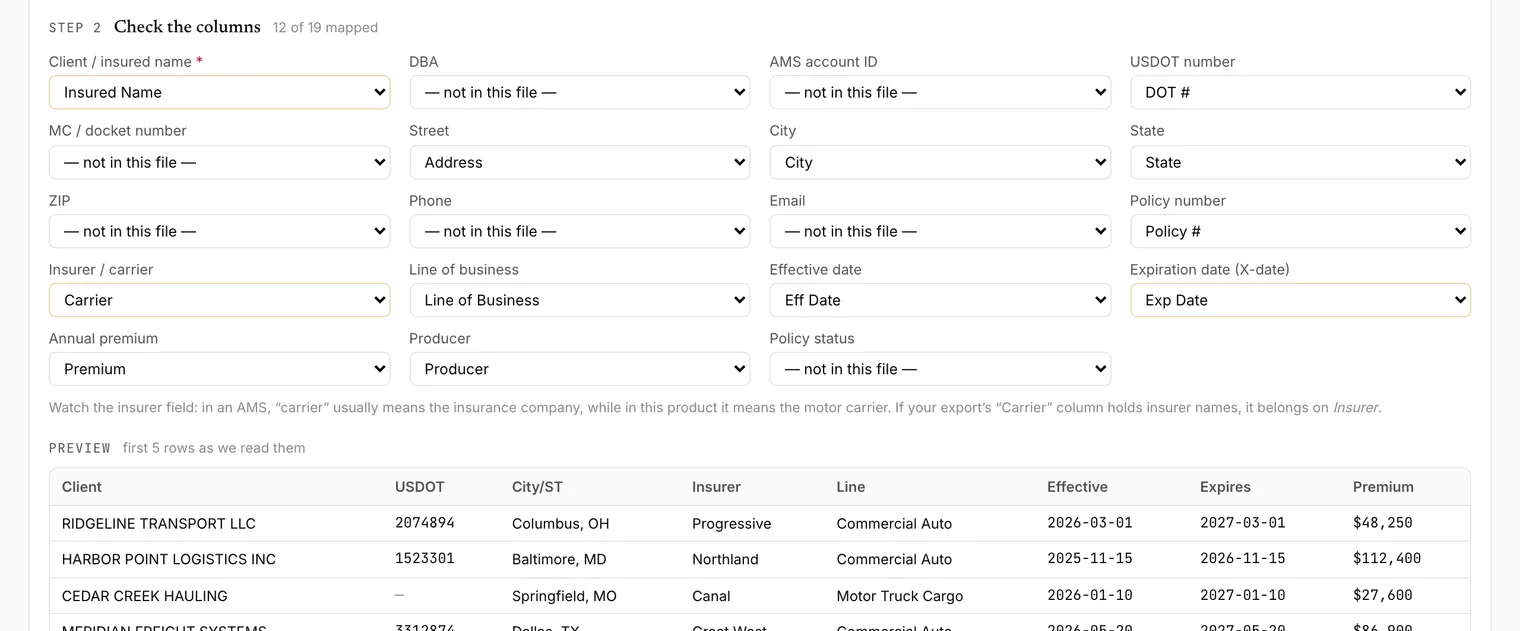
- Check the columns. Market Tracker proposes a mapping; correct anything it got wrong.
- Preview the result before committing.
- Import.
The matcher works from USDOT number where your export has one, and falls back to name and address matching where it does not. A cleaner export matches better: a USDOT column is worth adding at the source if your AMS can emit one.
Limit
There is a maximum number of rows per import. See Limits and caps.
#Match states
The tabs across the top are the four states every account lands in:
| Tab | Meaning |
|---|---|
Needs review | Matched, but not confidently: check these |
Matched | Confidently matched to a carrier |
Not found | No carrier matched |
All | Everything |
Work Needs review first. Not found is often a non-trucking account in the same export, which is expected.
#The stats row
Accounts, Matched, Needs review, Policies, Renewing in 90d, Premium on file.
Premium on file is whatever premium your export contained. Market Tracker does not have premium data of its own: no public source carries it.
#Calibration
Our X-dates vs your book compares Market Tracker's estimated renewal dates against the real ones in your export. This is the fastest way to find out how far to trust the estimates for the kind of business you write, on your own accounts, rather than in the abstract.
Background: What is an X-date in insurance?
#Signals
Your book against live FMCSA data raises five signals:
| Signal | Why it matters |
|---|---|
Insurer on file is not yours | The federal record shows someone else writing an account you think is yours |
Authority ends on a known date | A dated authority event is coming |
Active authority, no BI/PD on file | An operating client with no required filing |
Operating authority not active | The client is not currently authorised to operate |
Renewing in the next 90 days | Renewal window |
The first one is usually the one that costs money, and it is the one nobody notices manually.
#Prospecting from your own book
Find more like your book builds a profile from what you already write and points at similar carriers you do not. Pair it with the My book filter on Carriers set to Hidden to keep existing clients out of a prospecting list.
#Where signals go
Signals become tasks in the work queue.
Moving a book rather than monitoring one? How to roll a book of business covers the sequence and where rolls go wrong.
Last reviewed